

By: Cybermax Admin (AP)
In today’s digital world, data is not just a sheer information, it is the foundation of every decision, operation, and customer experience. Businesses, governments, and entire economies depend on uninterrupted access to accurate and secure data. However, this dependence brings significant risks, including cyberattacks, hardware malfunctions, natural disasters, and even simple human errors, all of which can lead to critical data loss. Therefore, backup has evolved from a mere technical formality to a strategic imperative. Lacking a robust backup strategy can result in business interruptions, loss of customer trust, and irreparable harm to your brand and operations.
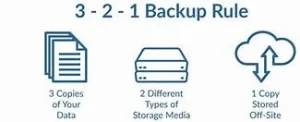
This is where the 3-2-1 Backup Rule comes into play; a straightforward yet powerful framework that is widely recommended for data protection. Like its name, the concept is clear and easy to remember:
- 3 Copies of Your Data: Keep at least three copies of your data. This includes the original data and two backups. This redundancy helps protect against data loss.
- 2 Different Storage Media: Store the copies on at least two different types of storage media. For example, you could use an internal hard drive and an external hard drive, or a combination of a physical drive and cloud storage. This reduces the risk of both copies being affected by the same issue.
- 1 Offsite Backup: Keep at least one copy offsite. This means storing a backup in a different physical location, such as a cloud service or an external drive stored at a friend’s house. This protects your data in case of local disasters like fires or floods.
This layered strategy allows you to bounce back fast, reduce downtime, and maintain operational continuity even under pressure. It also ensures that your data is safe and recoverable in case of hardware failure, data corruption, or other disasters.
Consider the incident in June 2024, when Indonesia’s National Data Center experienced a major outage, disrupting over 200 public services, including immigration and customs. Although this was not due to ransomware, the system failure underscored a harsh reality: no system is entirely immune. Without a robust recovery plan, the damage can escalate rapidly. If a comprehensive 3-2-1 backup strategy had been implemented and tested, services could have been restored much faster, saving time, costs, and public trust. Data protection should be a top priority. Losing data isn’t just a technical failure; it’s a failure to safeguard everything you have worked for. Do not wait for a disaster to reveal the importance of backups
So, what are you waiting for? Start building your backup strategy now before it is too late. Business continuity does not begin with recovery, it begins with preparation. The 3-2-1 Backup Rule offers a simple, scalable framework that safeguards not only your data, but also your organization’s resilience and reputation. In a risk-laden environment, ensure your backup strategy is strong enough to serve as your first and most reliable line of defence. Because when disruption strikes, preparedness is what keeps your business moving forward.


